- Engagement Rings
- Wedding Bands
Shop by style
- Classic
- Diamond Cut
- Two Colour
- Diamond Set
- Shaped
- Vintage
- Gemstone Bands
Shop by metal
- Gemstones
- Fine Jewellery
Fine Jewellery
- About Us
- Education
3 September 2026
What Width Should Your Wedding Ring Be? 2mm to 8mm on the Hand
What width should your wedding ring be? A useful guide should show what every millimetre changes, not declare one number correct for everyone. Width controls how much finger the band covers, how strongly it reads from a distance and how it sits beside other rings.
It can also influence fit, weight, engraving space and price. Use the Kinzy create-your-own-ring builder to establish the visual direction, then compare the intended width on your own hand before approving it.
What Wedding Ring Width Actually Measures
Width is the distance across the band from one edge to the other when viewed on the finger. A 2mm ring covers a narrow strip; an 8mm ring covers four times that distance. Width is not the same as depth, which measures how far the band extends away from the finger.
It is also separate from ring size. The ISO 8653 ring-size standard defines a method for measuring and designating internal size, while width describes the band’s visible span. Both measurements need to be recorded.
A product image enlarged on a screen can disguise scale. Ask for millimetres in writing and compare them with a ruler or full-width sample.
What Width Should Your Wedding Ring Be? 2mm to 8mm Compared
- 2mm: very fine and understated, with minimal finger coverage.
- 3mm: slim and clearly visible without feeling broad.
- 4mm: balanced presence on many hands and easy to read as a complete band.
- 5mm: a stronger visual line with more room for surface finish.
- 6mm: broad and substantial, making profile and inside fit more noticeable.
- 7mm: deliberately wide, with a confident area of metal across the finger.
- 8mm: a statement width that needs careful sizing and proportion testing.
These descriptions are visual guides, not gender rules. A 3mm band can look bold on one hand and delicate on another; an 8mm ring can look balanced where finger length and personal style support it.
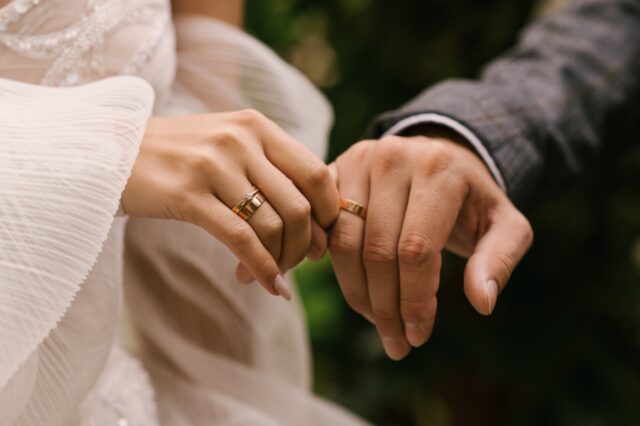
What a 2mm Wedding Ring Looks Like
A 2mm band creates a fine line of metal. It suits someone who wants the wedding ring to remain quiet, or who needs to preserve space beside an engagement ring and perhaps a future eternity ring.
That delicacy should be judged as construction, not only appearance. Depth, alloy, finger size and any setting detail determine whether a very narrow design is appropriate. Do not assume that reducing width always makes a ring more comfortable or less expensive.
Beside a delicate engagement ring, 2mm can create close visual continuity. Beside a very broad shank, the contrast may be intentional or may make the wedding band disappear. Compare the pair using Kinzy’s guide to solitaire and shoulder-set engagement rings.
What a 3mm Wedding Ring Looks Like
At 3mm, a band remains refined but has a clearer outline. There is more visible metal for a polished, satin or brushed treatment, while the ring can still sit neatly in a stack.
This width often appeals to people who find 2mm too fine but do not want a substantial band. “Often” is not “always”: try 2mm, 3mm and 4mm together because a one-millimetre step is easier to understand on the hand than on a specification sheet.
What a 4mm Wedding Ring Looks Like
A 4mm band establishes a confident middle scale. It has enough surface to show an exterior profile and finish clearly, yet it does not automatically dominate the finger.
For someone who rarely wears rings, 4mm can be a useful comparison point. Place narrower and wider samples on either side of it, then notice which one feels visually settled rather than merely familiar.
If the ring will accompany a raised setting, Kinzy’s low-set versus high-set guide helps separate vertical height from the wedding band’s horizontal width.
What a 5mm Wedding Ring Looks Like
At 5mm, the band becomes a more prominent part of the hand. Curvature across the outside, edge shape and finish become easier to see, so small specification changes have greater visual effect.
A 5mm ring can also offer more room for an internal inscription than a very narrow band, subject to its depth and inside profile. Confirm the actual engraving area rather than choosing width solely for a message.
What a 6mm Wedding Ring Looks Like
A 6mm wedding ring reads as broad and deliberate. It suits a wearer who wants the band to have presence without relying on diamonds or complex detail.
Because it covers more skin, full-width sizing matters. Try the intended inside profile and move the hand naturally. A narrow finger gauge carrying the same size will not reproduce the contact or edge sensation of the finished ring.
For care expectations around a regularly worn precious-metal surface, read Kinzy’s ring care guide and published Lifetime Atelier Care information.
What 7mm and 8mm Wedding Rings Look Like
Seven and eight millimetres create a strong block of colour and finish across the finger. A flat polished surface can feel architectural; a rounded exterior softens the same nominal width; a brushed finish can make the broad plane feel quieter.
These widths deserve the most careful comparison of finger length, knuckle, inside curvature and depth. Check that the edge does not interfere with the finger joint during a relaxed fist. If 8mm looks right but feels restrictive, changing the profile or inside geometry may preserve the presence better than abandoning the width immediately.
A broad band can be beautifully restrained. The goal is proportion, not an assumption that width must be decorated.
Finger Length and Hand Scale Change the Result
The same 5mm sample will not occupy the same proportion of every finger. Look at the space between the base of the finger and the first joint, not only overall hand size. A long finger may carry width easily; a shorter space may make the band feel visually compressed.
Knuckle size matters separately. The ring must pass the widest point and still sit securely below it. Test the exact width in neighbouring sizes instead of applying an automatic size increase.
Kinzy’s common ring-buying mistakes article explains why a specification should never replace looking at the real object on the hand.
How Width Works in a Bridal Stack
When an engagement ring and wedding band sit together, their combined width determines how high the stack travels up the finger. Add a possible eternity ring and the total may be very different from trying the wedding band alone.
Test whether the engagement ring still sits naturally and whether the wedding band remains visible beneath the centre setting. Kinzy’s engagement-ring settings guide helps identify baskets and galleries that affect the pairing.
This is a proportion check, not a repeat of a client-story design. For general diamond styles, use the dedicated diamond wedding-band guide.
Width, Profile and Depth Must Be Kept Separate
A 6mm flat band and a 6mm rounded band share width but present different amounts of flat surface. A D-shaped exterior gathers the visual weight towards the centre, while a flat exterior holds it across the full plane.
Depth changes physical substance and edge presence without altering the stated width. Inside curvature changes contact with the finger. Record all three dimensions so “6mm wedding ring” does not become the entire brief.
Kinzy’s design-process overview shows why precise geometry belongs in the approval stage.
Metal Changes Colour and Heft, Not Millimetres
Platinum and the different colours of gold alter the visual effect of a given width. Warm yellow gold can make a broad band feel rich and graphic; a white metal may blend more closely with white-diamond jewellery. The millimetre measurement remains the same.
The World Gold Council explains that 18-carat gold contains 75 per cent gold, with other metals forming the alloy. Compare metals through Kinzy’s platinum and gold guide, then return to width as its own decision.
A wider or deeper band generally contains more metal than a narrower, shallower version of comparable size and construction. Request the actual quotation; do not estimate price from width alone.
Finish Becomes More Visible as Width Increases
A 2mm polished ring offers a fine flash of reflection. On 6mm or 8mm, the same polish becomes a broad mirror-like plane. Satin, brushed, hammered or engraved finishes similarly gain more visible area as width increases.
Consider how the finish will develop with wear and whether the edges remain polished or share the same treatment. The width should support the intended surface rather than being chosen independently of it.
Engraving and Hallmarks Need Space
A wider interior may offer more room for engraving, but depth and inside profile still control usable space. Confirm the exact inscription, character length and placement before manufacture.
Engraving is personalisation; a hallmark verifies precious-metal fineness where UK law requires it. The British Hallmarking Council’s consumer guidance explains what buyers should look for when purchasing precious-metal jewellery online or in a shop.
How to Compare Widths Without Guessing
- Choose the likely metal, because colour changes visual presence.
- Place 2mm, 4mm, 6mm and 8mm samples on the hand to establish the broad direction.
- Compare the neighbouring millimetre widths around your preferred sample.
- Match the outer profile, inner profile and approximate depth.
- Wear any engagement ring or other band that will sit beside it.
- Bend the fingers, make a relaxed fist and pass the sample over the knuckle.
- Record width, size, depth, profile, metal and finish together.
Return to the Kinzy wedding-ring builder with those facts. If the available online description does not resolve a dimension, ask Kinzy before ordering.
See Width in Proportion
A clean solitaire provides a useful scale reference when judging the wedding band’s width beside an engagement ring.
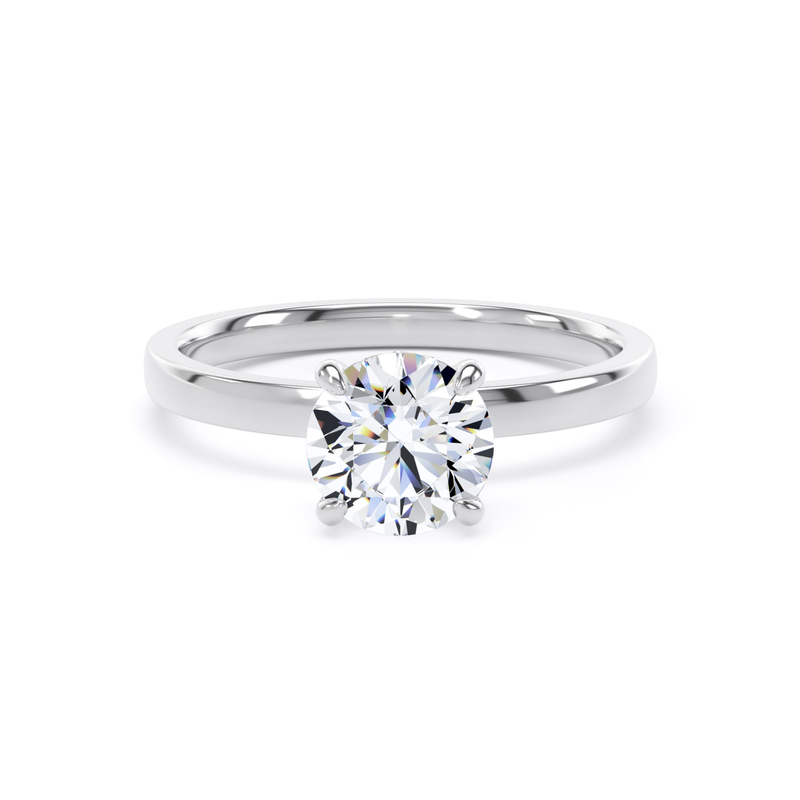
Wedding Rings in Balance
See how the width of a wedding band changes its balance beside an engagement ring.
Frequently Asked Questions
What is the most popular wedding ring width?
Popularity is not a fit standard and can change. Compare several widths on your own hand; the right number is the one that balances presence, comfort and any neighbouring rings.
Is a 2mm wedding ring too thin?
Not automatically. Its suitability depends on the material, depth, finger size and design details. Ask the maker to confirm that the complete specification is appropriate rather than judging width alone.
Is 4mm a narrow or wide wedding band?
It usually reads as a middle-scale width, but hand proportions alter the effect. Compare it directly with 3mm and 5mm samples.
Does a wide wedding ring need a larger size?
It can feel tighter because it covers more skin, but there is no universal size adjustment. Use a full-width sizing sample in the baseline and neighbouring sizes.
Should two partners choose the same width?
No. Rings can coordinate through metal, finish, profile or engraving while using widths suited to different hands. Kinzy’s analyses of Tom Holland and Zendaya’s bands and Cristiano Ronaldo and Georgina Rodríguez’s bands discuss coordinated rather than identical design.
Can I choose wedding-ring width online?
Yes, use the builder to compare the available visual options. Confirm the millimetre width at life size, together with ring size, depth and profile, before the final order.
Final Thoughts on Wedding Ring Width
What width should your wedding ring be? The best answer is confirmed on the hand. Two to three millimetres creates a refined line, four to five creates balanced presence, and six to eight makes width a defining part of the design—but none of those ranges replaces personal comparison.
Explore the options in Kinzy’s create-your-own-ring builder, then book a private consultation to confirm the width, size, profile, depth and finish together.
×
WEDDING RING CONSULTATION
Tell us what you are considering.
A short, considered brief. Nothing needs to be certain yet.
This site is protected by reCAPTCHA and the Google Privacy Policy and Terms of Service apply.
WEDDING RING CONSULTATION
Choose a wedding ring that feels entirely yours.
From proportion and comfort to finish and fit, a short brief lets your Kinzy jeweller prepare considered options before your consultation.
Related Reading
- Diamond Wedding Bands London: How to Choose the Perfect Ring to Wear for Life
- Platinum vs Gold Engagement Rings: Which Metal Should You Choose?
- Engagement Ring Settings Explained: How to Choose the Right Style
- Why Clients Choose a Hatton Garden Jeweller
- Engagement Ring Care Guide: How to Protect Your Ring for Life
Articles
Other articles from Kinzy London.
Articles, Bespoke Jewellery, Engagement Rings, Gemstones
How to Add a Hidden Birthstone or Secret Diamond to an Engagement Ring
Articles, Diamond Guides, Engagement Rings, Settings
Does a Bezel Setting Make a Diamond Look Bigger or Smaller?
Articles, Craftsmanship, Engagement Rings, Settings