- Engagement Rings
- Wedding Bands
Shop by style
- Classic
- Diamond Cut
- Two Colour
- Diamond Set
- Shaped
- Vintage
- Gemstone Bands
Shop by metal
- Gemstones
- Fine Jewellery
Fine Jewellery
- About Us
- Education
9 September 2026
Matching vs Complementary Wedding Rings: How Couples Can Coordinate Without Choosing Identical Bands
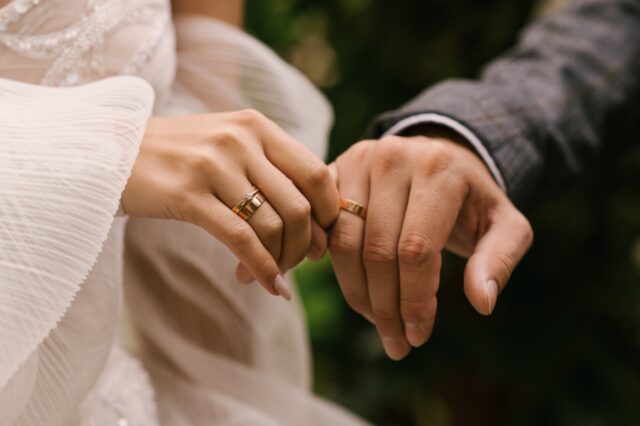
Matching vs complementary wedding rings is not a choice between romance and individuality. Two bands can share every visible detail, echo one carefully chosen element or look entirely different while carrying the same private engraving. The strongest pair expresses the couple without asking either wearer to compromise on comfort.
Instead of beginning with “Should our rings match?”, begin with “What should connect them?” Metal colour, profile, finish, proportion, detail and inscription all offer different levels of coordination.
What Are Matching Wedding Rings?
Matching wedding rings repeat the same core design. They may use the same metal, profile, finish and decorative detail, with width and finger size adjusted for each wearer. The resemblance is immediately visible when the hands are together.
This approach appeals to couples who want the rings to function as an unmistakable pair. It can also simplify decision-making because one agreed design language guides both bands. However, matching should not mean copying dimensions regardless of the hand.
A 2.5 mm and a 5 mm band can still be matching when the profile and finish are shared. Scaling the design thoughtfully often creates a more convincing pair than forcing identical widths.
What Are Complementary Wedding Rings?
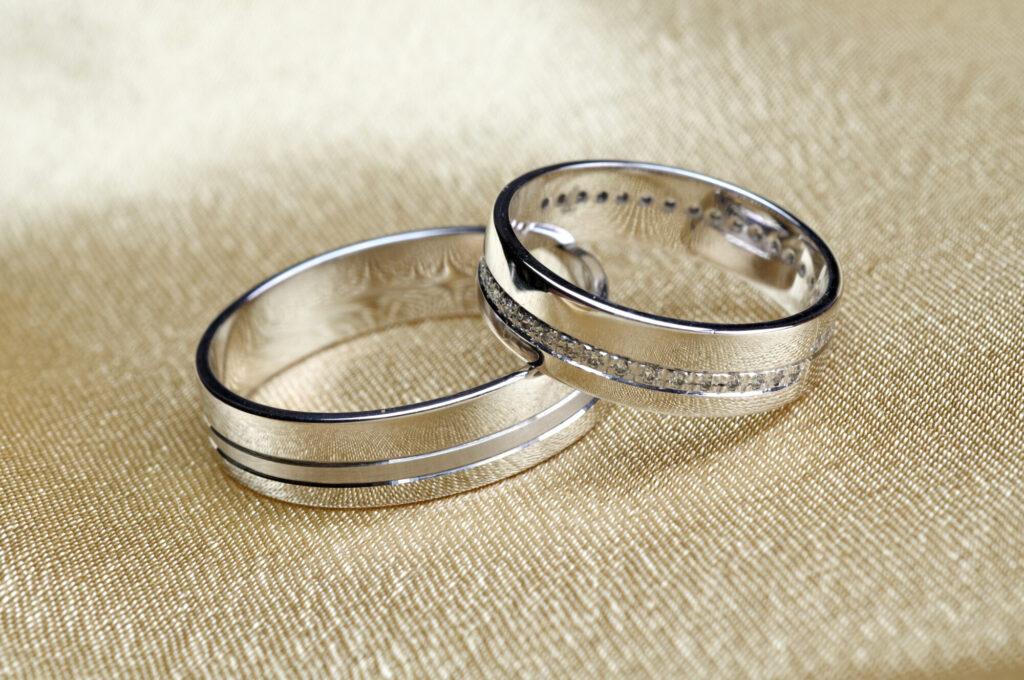
Complementary bands share selected cues while remaining distinct. One may be plain and the other diamond-set. One may be wider or use a different finish. The connection might be the same 18ct gold, a repeated bevel, a narrow polished edge or an engraving hidden inside both rings.
This route is useful when tastes, work or jewellery habits differ. It creates unity through intention rather than duplication. The rings should feel related when explained or seen together, but each should remain complete on its own.
A Third Option: Completely Individual Rings
Some couples choose bands with no visible relationship. That is equally valid. A shared date, phrase or experience can provide the connection without dictating appearance. The ritual and meaning do not depend on matching metal.
The danger is not difference; it is choosing without enough attention to how each ring will be worn. Whether coordinated or independent, both bands deserve the same consideration of profile, sizing, construction and long-term care.
Six Ways to Make Wedding Rings Feel Connected
1. Share the metal
The same metal colour creates immediate unity even when profiles and widths differ. Yellow gold can link a polished classic band to a diamond-set ring; platinum can connect a narrow court profile to a wider flat band.
Metal should still suit the individual design. Kinzy’s guide to platinum and gold rings explains the broader visual and ownership considerations.
2. Repeat the profile
A shared court, flat, D-shaped or softly rounded profile creates a subtler relationship than identical decoration. The outer profile affects light; the inner profile affects comfort. Both should be tried in the intended widths.
3. Coordinate the finish
Two polished bands feel formal and reflective. Satin or brushed finishes create quieter continuity. A polished edge around a textured centre can be repeated at different widths to preserve the motif while changing scale.
4. Use proportional width rather than equal width
Equal width is only one route. A narrower and wider ring can look balanced when the edge treatment, profile or finish is shared. The relationship should be judged on both hands, not in a tray where every ring has the same scale.
5. Repeat one detail
A bevel, groove, diamond, milled edge or contrasting line can become the visual signature. Restraint matters: repeating one detail is often more elegant than compressing every feature into both rings.
6. Connect the interiors
Engraving can create a private pair while leaving the exteriors entirely individual. Confirm the wording, type style, orientation and available space for each ring before manufacture.
Start with Each Person’s Daily Life
One wearer may use tools, gloves or gym equipment; the other may already wear an engagement ring and plan a layered stack. Different daily conditions can justify different widths, finishes and levels of stone setting.
Do not make one ring impractical to preserve a photograph of “matching” bands. A coordinated pair succeeds when both people can wear their chosen ring with confidence.
GIA’s jewellery-care guidance shows why the materials, gems and treatments in a piece affect suitable cleaning. Discuss realistic wear and care routines during the appointment rather than relying on an idealised lifestyle.
How an Engagement Ring Changes the Pairing
One wedding ring may also need to relate to an engagement ring. That creates two simultaneous conversations: the couple’s bands and the bridal stack. The solution can be complementary wedding rings that share a metal or finish while one is shaped or diamond-set to suit the engagement ring.
Check the engagement-ring profile through Kinzy’s settings guide and setting-height comparison. The couple’s connection should not ignore the physical fit of rings worn on the same finger.
Using Different Metals Intentionally
Complementary rings do not need the same metal. Yellow gold and platinum, or yellow and white gold, can suit different skin tones and existing jewellery while sharing profile or engraving.
Understand what each description means. The World Gold Council explains that gold is alloyed to create different colours and caratages. In the UK, qualifying precious-metal jewellery must follow hallmarking rules; the British Hallmarking Council’s consumer guidance explains what to look for.
If mixed colour is the visual connection, view the actual metals side by side. White gold, platinum and screen-rendered “silver tones” should not be assumed identical.
Plain and Diamond-Set Can Still Be a Pair
One wearer may want uninterrupted metal while the other prefers diamonds. Preserve unity through the same profile, edge or metal. Alternatively, set one discreet diamond into a mostly plain ring to echo the brighter band without copying it.
Stone setting changes care and possible future sizing, so it should never be added solely to make two rings appear more alike. Read Kinzy’s diamond wedding-band guide and compare the designs in ordinary light.
Make the Decision in the Right Order
- Choose a comfortable profile for each wearer.
- Set an appropriate width and depth for each hand.
- Resolve any fit with an engagement ring.
- Choose the desired metal or metal relationship.
- Add the shared visual cue: finish, edge, groove, stone or proportion.
- Confirm any private engraving and its orientation.
This order protects wearability before decoration. The Kinzy wedding-band builder can help each person explore a direction before both are reviewed together.
Design Together Without Forcing Agreement Too Early
Begin by selecting independently. Each person can identify three bands they would genuinely wear. Then compare the shortlists for recurring cues. The overlap may be obvious: both prefer warm gold, rounded profiles or low-key surfaces.
If there is no overlap, choose a private connection rather than manufacturing a visible one. Kinzy’s bespoke service and design process provide routes for developing proportion and detail around the actual brief.
Avoid These Common Coordination Mistakes
- Choosing identical widths without trying them on both hands.
- Prioritising a matching photograph over everyday comfort.
- Adding diamonds to one ring without discussing maintenance or future sizing.
- Assuming all white metals will look or age the same.
- Leaving engraving until after the available internal space has been fixed.
- Ignoring the engagement ring while coordinating the couple’s bands.
Plan the Appointment as One Conversation
Bring style references, existing rings and honest information about work and jewellery habits. View each band alone, beside its partner and—where relevant—within the engagement-ring stack.
You can explore Kinzy’s custom wedding-band builder in advance, learn about the Kinzy experience and then book a private consultation for both wearers.
Two Rings, One Design Story
Use one shared cue rather than assuming the two rings must be replicas. The builder allows each wearer to begin with their own preferences before a joined consultation.
Details That Connect
See how shared details can bring two wedding bands together without making them identical.
Frequently Asked Questions
Do wedding rings traditionally have to match?
No. Couples can choose identical, complementary or independent bands. Meaning comes from the commitment and chosen connection, not a compulsory design rule.
How can different wedding bands look coordinated?
Repeat one or two elements such as metal, profile, finish, edge detail or interior engraving while allowing width and decoration to differ.
Should both partners choose the same metal?
Only if it suits both. Different metals can still coordinate through form or finish. Each wearer should understand the care and appearance of their chosen metal.
Can one ring have diamonds while the other is plain?
Yes. Shared metal, profile or engraving can connect them. Stone setting should suit the relevant wearer’s lifestyle and future needs.
Can we design our Kinzy wedding bands together?
Yes. Begin with the online wedding-band builder, then arrange a joined appointment to compare both designs.
Final Thoughts on Matching vs Complementary Wedding Rings
Matching vs complementary wedding rings is best resolved by finding the right degree of connection. Let each ring fit its wearer first, then repeat the metal, profile, finish, detail or inscription that genuinely belongs to both.
Explore the Kinzy custom wedding-band builder and book a private consultation to develop the pair together.
Related Reading
Articles
Other articles from Kinzy London.
Articles, Bespoke Jewellery, Engagement Rings, Gemstones
How to Add a Hidden Birthstone or Secret Diamond to an Engagement Ring
Articles, Diamond Guides, Engagement Rings, Settings
Does a Bezel Setting Make a Diamond Look Bigger or Smaller?
Articles, Craftsmanship, Engagement Rings, Settings