- Black Friday
- Engagement Rings
- Wedding Bands
Shop by style
- Classic
- Diamond Cut
- Two Colour
- Diamond Set
- Shaped
- Vintage
- Gemstone Bands
Shop by metal
- Gemstones
- Fine Jewellery
Fine Jewellery
- About Us
- Education
18 September 2026
Full Bezel vs Half Bezel: Which Setting Is Right for Your Diamond?
The full bezel vs half bezel choice is about exactly where metal meets the diamond. A full bezel follows the complete perimeter. A half bezel—or partial bezel—secures selected sections while deliberately leaving other edges open.
That difference changes the visible outline, the areas protected from direct contact, the setting’s visual weight and the way you inspect it in future. It should be decided around the exact diamond, because a smooth oval, a clipped-corner emerald and a pointed marquise do not present the same geometry.
Full Bezel vs Half Bezel: The Essential Difference
In a full bezel, a continuous rim is worked over the girdle around the stone. Viewed from above, the metal traces the complete shape. In a half bezel, two or more sections secure the diamond and gaps reveal part of the girdle and side.
Terminology is not perfectly consistent across every jeweller. “Half bezel”, “semi-bezel”, “partial bezel” and “open bezel” may describe different proportions or contact points. Ask for a top, side and three-quarter drawing rather than approving a label by itself.
If you are still comparing a bezel with claws, begin with Kinzy’s general settings guide. This decision is narrower: how much of the perimeter the bezel should cover.
Coverage and Edge Protection
A full bezel places metal around the entire girdle and can reduce direct exposure along the edge. GIA’s technical discussion of diamond chipping risks identifies bezels and partial bezels among setting choices that can protect vulnerable areas.
A half bezel concentrates support and protection at selected positions. The open sections remain more exposed to knocks. That does not make the construction insecure when it is properly engineered, but it makes the location of each metal section especially important.
Ask the designer to identify which edges the bezel protects and which remain open. “More secure” is too vague without seeing the contact map.
The Stone Shape Should Lead the Layout
Round diamonds
A round stone has no pointed corner, so the partial-bezel positions can be arranged primarily around visual balance and stable contact. A full rim creates a precise circle; two opposing sections can give the same shape a lighter, more open expression. Kinzy’s round versus oval guide explains how even a small change in outline alters the hand.
Oval diamonds
An oval may be set north-south or east-west, and the bezel positions must work with that orientation. Leaving the long sides open exposes a different part of the outline from leaving the ends open. Explore the architectural effect through east-west engagement rings and evaluate the individual oval for symmetry and bow-tie visibility.
Cushion diamonds
Cushions range from softly square to distinctly elongated. A full bezel can clarify their perimeter, but it must follow the actual curves rather than an assumed generic shape. Compare the options in Kinzy’s elongated cushion guide.
Emerald and radiant cuts
Clipped corners create a tailored outline. A full bezel can repeat every corner and straight edge; a half bezel can expose sections of the long sides. The choice should respect the stone’s precise measurements and visual rhythm. See radiant versus emerald-cut diamonds before selecting the frame.
Pears and marquises
Pointed ends require deliberate protection. A partial bezel may be designed to cover vulnerable points, but an arrangement that leaves them exposed serves a different practical brief. The pear versus marquise guide explains why symmetry and tip protection deserve attention.
How the Outline Appears
A full bezel draws one unbroken line around the diamond. In a matching white metal, it can merge visually with a colourless stone. In yellow or rose gold, it can give the diamond a warm graphic border. This framing effect may make the face-up footprint feel broader when the rim remains fine.
A half bezel alternates metal and exposed stone. It can preserve more of the naked outline, particularly along elongated sides, while making the supports part of the design. The eye sees a sequence rather than a continuous boundary.
GIA notes in its discussion of settings and apparent size that a bezel can influence perceived circumference. That is a visual effect, not a change in carat weight or measurements.
Light: Avoid the Open-Sides Myth
A half bezel exposes more of the side, but that alone does not guarantee a brighter diamond. A well-cut diamond is designed to return light entering from above. Cut quality, cleanliness, crown visibility and the proportions of the setting remain decisive.
A full bezel should not climb unnecessarily over the crown. A partial bezel should not use heavy sections that overpower the exposed gaps. Choose the diamond first, then assess the setting in CAD or a model around its real dimensions. Kinzy’s certification guide explains why a report supports—but cannot replace—visual assessment.
Height and Side Profile Are Separate Decisions
Both full and half bezels can sit on a low or raised gallery. A continuous rim does not automatically mean a low-profile ring, and an open bezel is not necessarily high. Cathedral shoulders, bridge clearance and under-gallery structure determine much of the side view.
Review low-set versus high-set engagement rings separately. Then check whether the future wedding band can pass beneath the head or whether a shaped band will be preferable.
Snagging and Surface Smoothness
A finely finished full bezel can create a smooth perimeter with no separate claw tips. That can appeal to someone concerned about knitwear, gloves or frequent catching. However, the whole setting may still project from the hand.
A half bezel also avoids conventional claws, but its transitions between metal and exposed diamond should be inspected. Sharp ledges, abrupt shoulders or a high gallery can catch even when the bezel itself looks minimal.
Cleaning Access
Open sections may improve direct access to parts of the diamond’s side. A full bezel can still include an open underside, allowing careful cleaning beneath the pavilion. The gallery design matters as much as the amount of girdle covered.
Residue around the rim can soften the diamond’s appearance. Follow the engagement-ring care guide and ask which home and professional cleaning methods suit the finished ring.
Maintenance and Repair
A full bezel should be checked for thinning, dents, lifted edges or diamond movement. A half bezel needs the same attention at every contact section, as well as inspection of the exposed edges. Neither setting is maintenance-free.
GIA recommends regular setting checks in its guidance on protecting a diamond engagement ring. For a Kinzy creation, read the current scope of lifetime atelier care and follow the applicable schedule.
Metal Colour and Proportion
A full yellow-gold rim creates a continuous warm outline; a partial yellow-gold bezel introduces warm accents separated by visible diamond. Platinum or white gold can visually recede, although the exact effect depends on width and polish.
The decision between platinum and gold should include the complete ring, not just the top frame. Ask whether the setting and shank use the same metal and how that will appear from the side.
Wedding-Band Fit
A full or half bezel can be built with enough clearance for a straight wedding ring, or it can sit low enough to require a gap or contour. The word “bezel” does not answer the fit question.
Use Kinzy’s diamond wedding-band guide to decide how much sparkle and separation you want. Ask to see both rings together in profile before the engagement-ring design is final.
Resizing and Construction Around the Shank
Resizing usually depends more on the lower shank, shoulders and any diamonds around the band than on whether the centre has a full or partial bezel. An all-round or highly structured design can limit alteration.
Confirm the anticipated sizing range before approval. The distinction between bespoke and made-to-order rings also matters when the setting must be developed around an unusually proportioned stone.
A Practical Decision Framework
Choose a full bezel when you value a continuous frame, smoother complete perimeter and maximum girdle coverage within this setting family. Choose a half bezel when you want visible interruptions in the frame, more exposed side and a more open architectural balance.
Then test the preference against four facts: the vulnerable parts of the actual diamond, desired orientation, overall height and future wedding-band fit. If one of those conflicts with the first aesthetic choice, redesign the bezel rather than forcing the stone into a standard idea.
Questions to Resolve Before Approval
- Exactly which percentage or sections of the girdle will be covered?
- Which edges, corners or points will remain exposed?
- Is “half bezel” being used for two side bars, two end caps or another layout?
- How wide will the metal appear from above?
- Can I review the setting around the exact diamond measurements?
- What access remains for cleaning?
- Will a straight wedding band sit beside the ring?
- Which areas should be checked during servicing?
- What resizing range is expected?
Study Bezel Proportion with Kinzy
Compare these full-bezel Kinzy designs to see how one continuous rim follows different diamond outlines. For a half bezel, review an exact CAD rather than relying on the label alone.
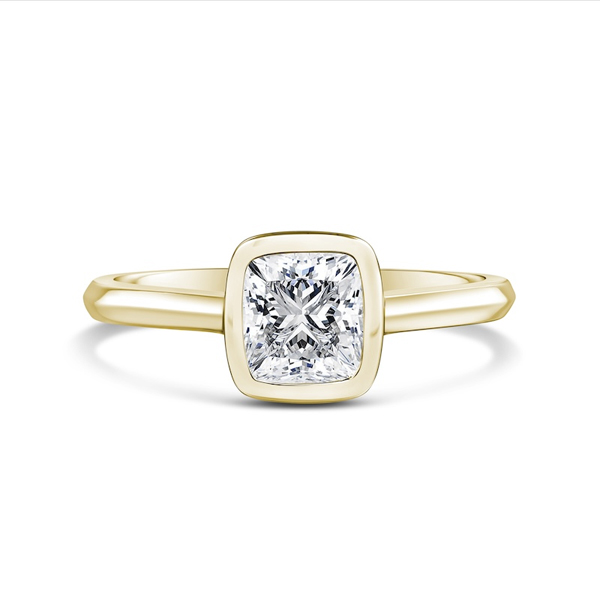
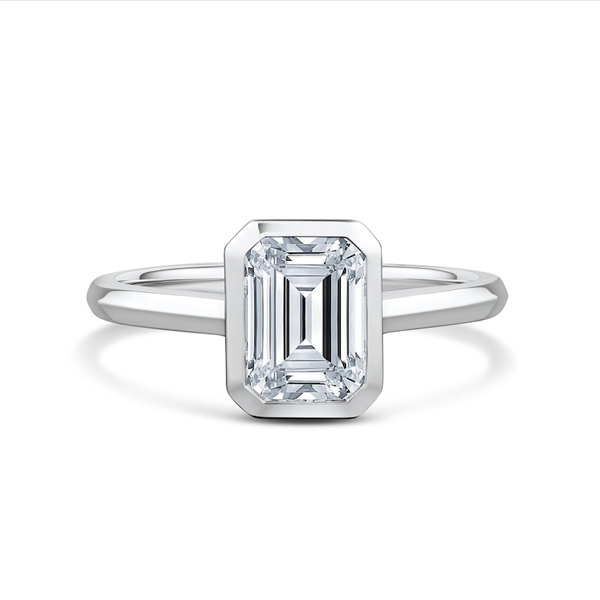
See Bezel Proportion Up Close
This Kinzy setting detail shows how the diamond’s outline and the surrounding metal are designed as one composition.
Frequently Asked Questions
Is a half bezel the same as a partial bezel?
The terms are often used similarly, but exact coverage can vary. Confirm the actual contact sections in drawings or a model.
Is a full bezel always more secure?
It covers more of the girdle, which can provide broader edge protection. Overall security still depends on proportion, workmanship, metal condition and wear.
Does a half bezel make the diamond brighter?
Not automatically. It exposes more side, but cut quality, cleanliness and crown visibility are more reliable determinants of visible brightness.
Which bezel is best for a pointed diamond?
The design should protect the vulnerable point deliberately. Either full or partial coverage may do that if the contact map is engineered for the exact shape.
Can both types sit flush with a wedding ring?
Yes, if the gallery and bridge provide sufficient clearance. The amount of bezel coverage does not decide band fit by itself.
Choosing the Bezel That Suits Your Diamond
The full bezel vs half bezel decision is a choice between a continuous frame and selected areas of metal contact. Full coverage protects and defines the complete perimeter; partial coverage opens sections of the outline and creates a lighter rhythm.
Explore Kinzy’s bezel design ideas, then book a private consultation to map the setting around the exact diamond rather than a generic name.
×
BESPOKE DESIGN BRIEF
Begin with what you know so far.
A short, considered brief. Nothing needs to be certain yet.
This site is protected by reCAPTCHA and the Google Privacy Policy and Terms of Service apply.
PERSONAL BESPOKE GUIDANCE
Shape the next detail with your Kinzy jeweller.
A short design brief gives our Hatton Garden atelier a thoughtful starting point—whether you have a clear idea or are still comparing possibilities.
Related Reading
Articles
Other articles from Kinzy London.
Articles, Buying Guides, Engagement Rings, Ring Settings
Choosing an engagement ring setting this Black Friday
Articles, Buying Guides, Diamond Jewellery
Diamond studs or a solitaire pendant? A Black Friday gift guide
Articles, Jewellery Education, Precious Metals