- Engagement Rings
- Wedding Bands
Shop by style
- Classic
- Diamond Cut
- Two Colour
- Diamond Set
- Shaped
- Vintage
- Gemstone Bands
Shop by metal
- Gemstones
- Ready To WearFine jewelleryMade to be worn.
Made to last.Diamond jewellery for every day and every occasion.Shop all jewellery →Fine jewellery
Diamond earringsPendantsBraceletsRingsShop allShop by occasion
Gifts under £1,000AnniversaryBirthdayBridal jewelleryAvailable sooner
Ready to dispatchNew arrivalsBestsellersBook an appointmentFine Jewellery
- About UsMade in LondonCrafted by people you can meet.Discover the people, workshop and personal service behind every Kinzy London piece.Meet KinzyRead our story →
About Kinzy
About KinzyOur storyClient storiesMeet your sales associateCraft & care
Our workshopDesign processLifetime Atelier CareOur guaranteesMade in our London workshopCertified diamondsLifetime carePersonal guidance - Education
Learn with Kinzy Diamond guideUnderstand the details that matter→Fit & setting guideChoose comfort and proportion→Behind the craftHow your jewellery is made→Expert guidance, clearly explained.
Practical diamond, gemstone and ring guidance to help you make a confident decision.
Explore all guides →
 Round
Round Oval
Oval Heart
Heart Marquise
 Cushion
 Pear
Pear Emerald
 Asscher
 Radiant
22 September 2026
Wed-Fit Engagement Rings: Planning a Close Wedding-Band Pairing
Wed fit engagement rings are designed with enough space beside the centre setting for a wedding band to approach closely, often without needing a curve or notch. The idea is simple; the execution depends on the ring’s gallery, bridge, shoulders and the exact wedding band chosen later.
“Wed-fit” is useful retail language, not a promise that every straight band will sit perfectly against every engagement ring. Bands differ in depth, edge profile, width and diamond setting. The safest interpretation is therefore architectural: the engagement ring has been planned to make close pairing possible, and the finished combination still needs to be tested.
What Makes an Engagement Ring Wed-Fit?
Look at the engagement ring from the side. The lowest part of the centre setting must leave a clear route for the wedding band. If a basket, halo, claw base or decorative gallery extends down to finger level, a straight band will meet that structure before its edge reaches the engagement-ring shank.
A wed-fit design raises, narrows or reshapes the relevant architecture so the companion ring can pass beside it. This does not always mean a conspicuously high setting. Kinzy’s guide to engagement-ring settings explains the component names, while the comparison of low-set and high-set rings shows why overall height and wedding-band clearance are related but not identical decisions.
The Bridge Is the Critical Line
The bridge is the portion beneath the centre setting that spans between the shoulders. On some rings it forms a neat elevated bar above the finger. On others, the basket or decorative work descends lower. The height and width of this area often determine how far a wedding band can travel.
Ask to see the ring at finger level rather than relying on a face-up image. A design can look open in profile yet still have a projecting point near the base. Conversely, an intricate gallery may retain a clean, continuous line beside the shank.
Shoulders Can Block a Band Too
Clearance is not only about the centre basket. Cathedral shoulders rise towards the setting and can broaden as they climb. Split shoulders, side stones and sweeping pavé elements may begin close to the finger. If their lower edges project beyond the shank, they can meet the wedding band.
The transition should be read from several angles. Browse Kinzy shoulder-set engagement rings and compare where the diamonds stop, where the polished lower band begins and how the shoulders meet the head.
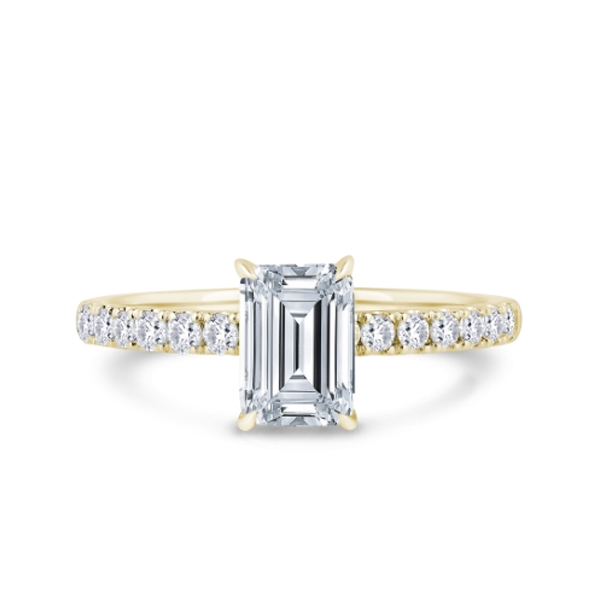
Halo and Hidden-Halo Details Need a Side View
A face-up halo surrounds the centre stone, but its lower edge may be wider than the shank. A hidden halo sits beneath the stone and can project towards the wedding band even though it is barely visible from above. Neither detail automatically prevents a close fit; its position is what matters.
Use Kinzy’s hidden vs traditional halo guide to separate the two effects. Then inspect the physical ring or a precise side elevation. A beautiful hidden detail should not be assumed to create clearance merely because it is discreet.
Side Stones Create Their Own Geometry
Trilogy rings and side-stone designs carry more setting structure across the finger. The side baskets, rails or claws may extend lower than the centre. A wedding band needs room along that complete span, not just beneath the central diamond.
Elongated or angled side stones can also create contact points near a diamond girdle or claw. Kinzy’s trilogy engagement rings show how varied these outlines can be. For a bespoke design, assess the planned wedding-band section against the exact three-stone arrangement.
Flush Appearance Is Not the Same as Safe Contact
Two rings can appear flush from above while touching at only one vulnerable point beneath. Repeated rubbing against a fine claw, pavé edge or exposed diamond is different from broad metal-to-metal contact. The pairing should be inspected while stationary and with normal movement on the finger.
A tiny, even line of space may be preferable to forced contact. Wed-fit architecture creates options; it should not turn “no visible gap” into an absolute requirement. The finished stack must work as jewellery, not just satisfy a top-view photograph.
The Wedding Band’s Profile Still Matters
A straight band can have a flat, court, D-shaped or other profile, and its edge can sit low or rise prominently. Two wedding bands of the same width may therefore approach the engagement setting differently. Diamond setting can add further height or exposed edges.
Start with Kinzy’s diamond wedding-band guide, then compare plain and diamond-set samples directly with the engagement ring. The correct question is not simply “Will a straight band fit?” but “Will this particular band fit in the intended position?”
Plan Both Rings at the Engagement-Ring Stage
The most controlled route is to state the desired pairing before the engagement-ring design is final. If a straight, close-fitting wedding band is important, it can influence bridge height, shoulder spread and gallery detail from the beginning. If a shaped band or deliberate space is preferred, the engagement ring can remain lower or more sculptural.
Kinzy’s design process sets out the stages of a bespoke commission. The behind-the-scenes bespoke guide is especially relevant: stone dimensions affect the head, and the head determines much of the clearance below.
Use CAD to Inspect Clearance, Not to Imagine Comfort
A computer-aided design can show a side elevation, the space beneath a bridge and the relationship between two modelled rings. Ask to see the engagement ring and intended wedding-band section together, with dimensions rather than perspective alone.
CAD cannot reproduce every sensation on the hand or predict every future band. Kinzy’s design-process overview shows where digital development fits within the wider commission. A wax or physical sample can add tactile context where the process includes one.
Can an Existing Engagement Ring Be Made Wed-Fit?
Sometimes an existing setting can be modified or remade, but this is not a universal adjustment. Changing the bridge or head may affect stone security, shoulder alignment, hallmarking considerations and the appearance of the entire ring. It requires examination by a qualified jeweller.
Often the more proportionate solution is a wedding band shaped around the existing ring. That is different from changing the engagement ring itself. If you already own the piece, bring it to a Kinzy consultation so the actual geometry can be assessed rather than inferred from photographs.
Trade-Offs of Wed-Fit Engagement Rings
- More pairing flexibility: a straight band may sit closer and future stack choices can be simpler.
- Potentially greater height: creating clearance can place parts of the setting higher than an ultra-low alternative.
- Different profile character: an elevated bridge may look airier or more architectural from the side.
- No universal guarantee: the final wedding band still needs to be checked for width, depth and contact.
These are design choices, not defects. The right priority depends on whether the wearer values the lowest possible setting, a straight-band stack, a particular gallery motif or a precise balance of all three.
Your Wed-Fit Inspection Checklist
- View the engagement ring directly from the side at finger level.
- Identify the lowest point of the bridge, basket, halo and side settings.
- Place the intended wedding band beside it without forcing either ring.
- Check contact around claws, diamond edges and pavé borders.
- Look at the gap from above, beneath and from both sides.
- Wear the pair briefly to observe rotation and comfort.
- Record the wedding band’s width and profile if it will be made later.
Care for a Close-Fitting Bridal Set
Rings worn together can mark one another where they make repeated contact. Inspect the pair for new movement or catching, and have settings checked if anything changes. GIA’s jewellery-care guidance also explains why the correct cleaning method depends on the gems and treatments present.
The GIA’s engagement-ring protection guidance also advises removing rings for activities that expose them to hard knocks or damaging chemicals. Kinzy clients can review current provisions under Lifetime Atelier Care.
Designed as a Pair
When a close, straight pairing matters, Kinzy plans the gallery, bridge and shoulders around the wedding band from the outset.
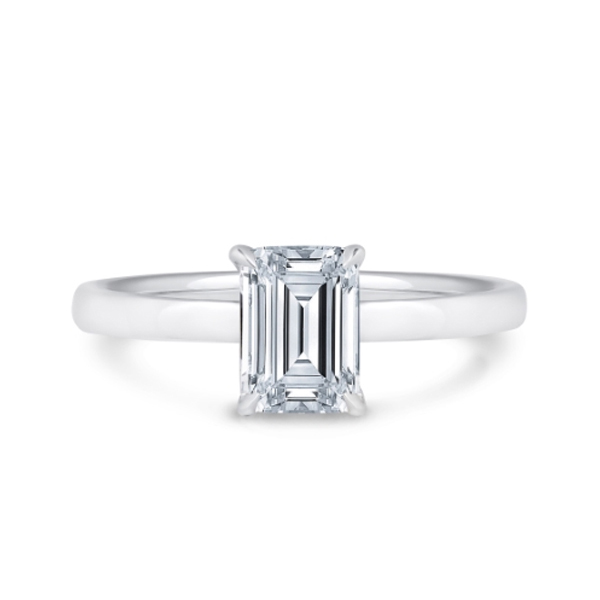
A Kinzy Bridal Pairing
See how an engagement ring and wedding band are balanced as one considered composition.
Frequently Asked Questions
Does wed-fit mean completely gap-free?
No. It means the engagement-ring architecture is intended to accommodate a wedding band closely. The actual result depends on the chosen band’s profile, depth and setting.
Can a low-set engagement ring be wed-fit?
It can be if the bridge and setting leave sufficient lateral clearance. However, an extremely low basket may occupy the same space as a straight wedding band.
Do I have to choose a straight wedding band?
No. A curved or contoured band may still be selected for its appearance, even when the engagement ring could accept a straight one.
Should I buy the wedding band at the same time?
You do not have to, but selecting or at least specifying its likely width and profile makes the engagement-ring clearance easier to plan accurately.
Can Kinzy check my existing ring for wedding-band fit?
Arrange a private consultation and bring the existing ring so its real bridge, setting and contact points can be examined.
Plan the Pair Before Either Ring Is Finished
A wed-fit design creates room for a close pairing, but the exact engagement ring and wedding band still need to be assessed together in three dimensions.
Explore Kinzy bespoke engagement rings, begin a wedding-band design through Create Your Own Ring, or book a consultation to plan both together.
×
RING PAIRING & FIT BRIEF
Let us consider the two rings together.
A short, considered brief. Nothing needs to be certain yet.
This site is protected by reCAPTCHA and the Google Privacy Policy and Terms of Service apply.
RING PAIRING & FIT
Review the pair before you decide.
A considered wedding-ring choice begins with the engagement ring already on your hand. Send a short brief and receive personal guidance from your Kinzy jeweller.
Related Reading
Articles
Other articles from Kinzy London.
Articles, Bespoke Jewellery, Buying Guides, Engagement Rings, Wedding Bands
Wed-Fit Engagement Rings: Planning a Close Wedding-Band Pairing
Articles, Bespoke Jewellery, Buying Guides, Engagement Rings
Thin-Band vs Wide-Band Engagement Rings: How Proportion Changes the Entire Design
Articles, Buying Guides, Engagement Rings, Ring Settings