- Engagement Rings
- Wedding Bands
Shop by style
- Classic
- Diamond Cut
- Two Colour
- Diamond Set
- Shaped
- Vintage
- Gemstone Bands
Shop by metal
- Gemstones
- Ready To WearFine jewelleryMade to be worn.
Made to last.Diamond jewellery for every day and every occasion.Shop all jewellery →Fine jewellery
Diamond earringsPendantsBraceletsRingsShop allShop by occasion
Gifts under £1,000AnniversaryBirthdayBridal jewelleryAvailable sooner
Ready to dispatchNew arrivalsBestsellersBook an appointmentFine Jewellery
- About UsMade in LondonCrafted by people you can meet.Discover the people, workshop and personal service behind every Kinzy London piece.Meet KinzyRead our story →
About Kinzy
About KinzyOur storyClient storiesMeet your sales associateCraft & care
Our workshopDesign processLifetime Atelier CareOur guaranteesMade in our London workshopCertified diamondsLifetime carePersonal guidance - Education
Learn with Kinzy Diamond guideUnderstand the details that matter→Fit & setting guideChoose comfort and proportion→Behind the craftHow your jewellery is made→Expert guidance, clearly explained.
Practical diamond, gemstone and ring guidance to help you make a confident decision.
Explore all guides →
 Round
Round Oval
Oval Heart
Heart Marquise
 Cushion
 Pear
Pear Emerald
 Asscher
 Radiant
23 September 2026
Split-Shank vs Single-Shank Engagement Rings: Finger Coverage, Balance and Resizing
A split shank vs single shank engagement ring comparison begins with one structural question: does the band remain a continuous line as it meets the setting, or divide into two or more arms? That decision changes the negative space around the centre stone, the amount of finger covered and the way the ring carries visual weight.
It does not determine quality by itself. A refined split can feel airy; a bold one can feel sculptural. A single shank can be whisper-fine, broad, tapered or diamond-set. The more useful choice comes from studying where the division begins, how it connects to the head and what happens around the palm.
What Is a Split-Shank Engagement Ring?
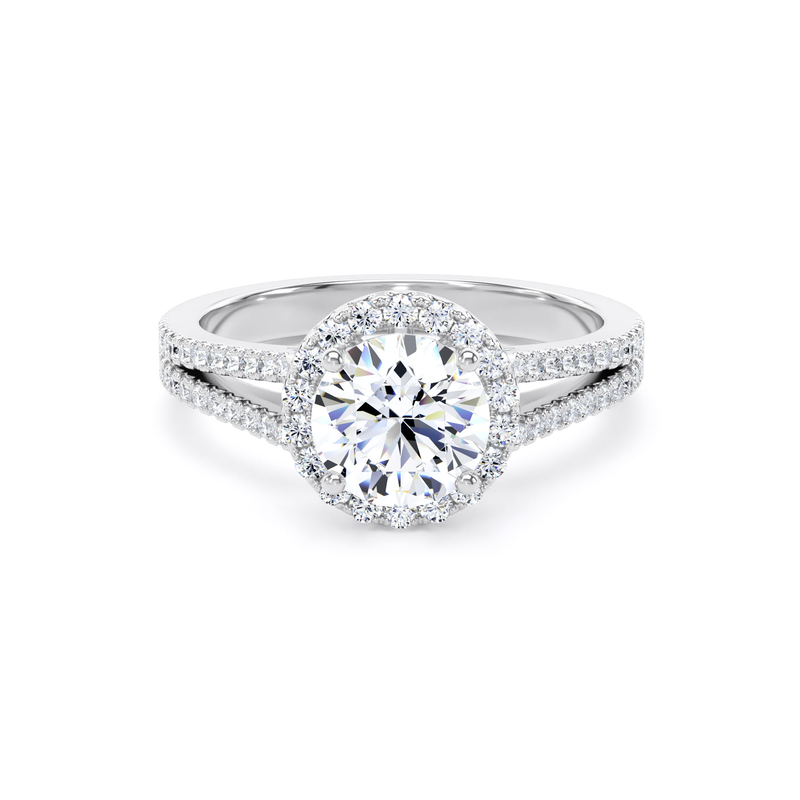
On a split-shank ring, the band separates as it approaches the centre setting. The opening may be a slender sliver of negative space or a wide, visible division. Some arms rise like cathedral shoulders; others sweep around a halo or meet different parts of a basket.
The lower band normally returns to a single section beneath the finger. Where that convergence occurs matters for comfort and any future work. Explore Kinzy’s live round split-shank halo engagement ring to see how divided shoulders can broaden the composition without making the entire circumference equally wide.
What Is a Single-Shank Engagement Ring?
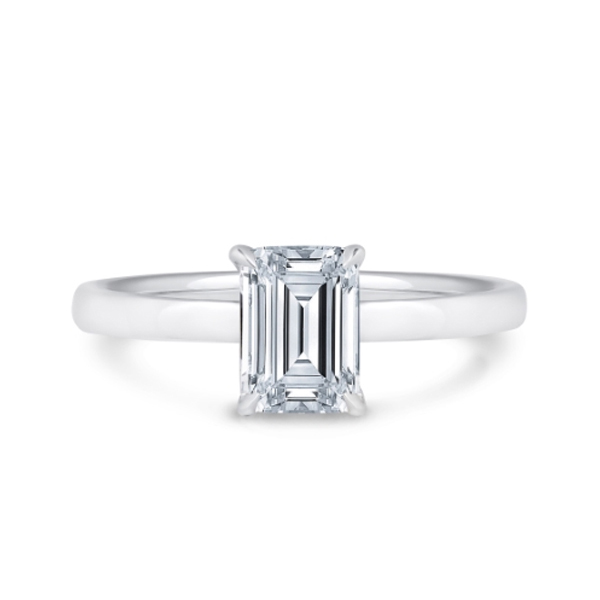
A single shank remains visually continuous as it travels towards the setting. Its shoulders can still taper, rise, twist or carry diamonds, but the eye follows one unbroken band on each side. This architecture is often associated with solitaires, although it supports halos and side-stone designs too.
“Single” does not mean plain or narrow. The surface can be sculpted, channel-set or pavé-set. Kinzy’s solitaire collection shows how many personalities a continuous band can have.
Finger Coverage: Metal and Empty Space Work Together
A split shank usually occupies more width near the centre setting, yet part of that area is open. It can therefore give the impression of greater coverage while remaining visually light. The amount of skin visible between the arms determines whether it feels delicate, graphic or substantial.
A single shank concentrates its material into one line. A wider continuous band may cover as much finger as a modest split, but the effect is denser. Do not compare outer width alone; compare metal width, opening width and the length of the split together.
How Each Shank Balances the Centre Setting
A broad halo or large centre can look grounded by divided shoulders because their outer lines approach more than one point on the setting. The split creates a visual transition from the width of the head to the narrower band at the palm.
A single shank can make the same centre look more isolated and prominent. Tapering the shoulders inward increases that contrast; widening them towards the head creates a steadier transition. Kinzy’s guide to engagement-ring settings helps identify how the head, gallery and shoulders participate in this balance.
Round, Elongated and Angular Stones Respond Differently
A round centre offers radial symmetry, so a split can frame it evenly. An oval or marquise already draws the eye along the finger; gently diverging arms can echo that length, while a single shank provides a clean cross-axis. Emerald and princess cuts invite straighter, more architectural transitions.
These are starting points, not rules. Compare round, oval and princess-cut engagement rings while focusing on the shoulder lines rather than changing every detail at once.
Split Shanks Can Frame Halos and Side Stones
A split gives the designer more than one route into the head. The upper arm might meet a halo edge while the lower arm supports the basket, or both may form a symmetrical frame. Diamond setting can continue along one or both arms, creating distinct ribbons of light.
That extra surface also introduces more junctions and edges to resolve. Spacing, stone size and the return to the lower shank should be harmonious. For halo context, see Kinzy’s comparison of hidden and traditional halo settings.
A Single Shank Gives the Eye a Clear Path
With no division, attention moves directly from the lower band to the centre setting. This can suit a design in which the diamond’s outline is intended to dominate. It also gives a polished metal surface, engraving or one precise line of shoulder diamonds room to read clearly.
The simplicity is visual, not necessarily technical. The head still needs to be built around the stone, and the shoulder connection must be proportionate. Kinzy’s behind-the-scenes bespoke guide explains why two apparently similar solitaires can require different architecture.
Comfort Depends on Where the Split Begins
If the division starts close to the palm, the ring may feel wider between neighbouring fingers. If it begins higher, the lower shank can retain the familiar feel of a single band. Edge shape, depth and the transition back into one section also influence comfort.
Try the ring in the correct size and move the hand naturally. Check whether the open section traps residue from hand cream or catches on fine fabric. Neither outcome is inevitable; they depend on spacing and finish. The Kinzy experience includes the opportunity to discuss these practical priorities alongside appearance.
Does a Split Shank Stop a Ring Spinning?
Greater coverage near the head may help some rings feel more settled, but a split shank is not an automatic anti-spin solution. Centre weight, fit over the knuckle, lower-shank width and finger shape all contribute. A top-heavy split ring can still rotate if the fit is unsuitable.
Assess balance with the intended centre stone in place or accurately represented. A sample with a very different head weight cannot answer the question reliably. Compare the fit standing, walking and using the hand rather than holding one ideal pose.
Wedding-Band Pairing Needs an Outline Check
The outer arms of a split shank may project lower or wider than a single band, especially in a cathedral or halo design. This can affect how closely a straight wedding ring approaches. Conversely, a raised split can leave a clean line at finger level.
View the complete profile and test the intended band. Kinzy’s wedding-band builder lets you begin the companion design, while the diamond wedding-band guide covers sparkle, setting and everyday considerations.
Resizing a Split Shank: Possible, but Design-Specific
A common claim says split-shank rings cannot be resized. That is too absolute. Many are altered through the single lower section, but the feasible amount and method depend on how soon the shank divides, whether diamonds extend around it, the metal, the setting and the size change required.
Maintaining symmetry is important. A change at the base can affect the curve and spacing of the upper arms if it is pushed beyond what the construction accommodates. The UK government’s technical publication on repairing and sizing ring shanks illustrates that sizing is a structural jewellery operation, not simply stretching a circle.
Is a Single Shank Easier to Resize?
A plain continuous lower band often gives a jeweller a less complex working area. However, a single-shank ring may still have full-eternity diamonds, intricate engraving, mixed metals or a setting that limits alteration. The category does not replace an assessment of the individual ring.
Before ordering, ask where sizing work would be carried out and what design features could restrict it. Obtain a reliable finger size rather than choosing an architecture mainly to accommodate an imagined future change.
Compare the Two Structures Fairly
- Keep the centre stone and setting family broadly consistent.
- Compare the outer width near the head and the width at the palm.
- Look at the negative space and where the split begins.
- Check balance and rotation in the correct finger size.
- Add a wedding-band sample and inspect the profile.
- Ask how diamond coverage and junctions affect future sizing and care.
For an individual design, Kinzy’s bespoke service can adapt the opening, taper and shoulder connections around the exact centre. The Kinzy design-process overview shows where those relationships are reviewed before manufacture.
Care and Inspection
Split arms create inner edges and junctions that deserve the same regular attention as claws and stone settings. Keep the openings clean without using abrasive methods, and seek advice if an arm appears distorted or a gap changes shape. A single shank should likewise be checked for thinning, impact and setting movement.
GIA’s jewellery-care guidance cautions that cleaning methods must suit the stones and treatments in the piece. Kinzy clients can also review Lifetime Atelier Care and its current terms.
Shaped Around the Centre Stone
The shank should frame the centre stone and settle naturally on the hand. Kinzy refines its split, taper and balance around the chosen diamond.
From Design to Finished Piece
See how each line is carried from the design into the finished Kinzy ring.
Frequently Asked Questions
Is a split shank wider than a single shank?
Usually near the setting, but not necessarily around the palm. Its outer span may be broad while the negative space keeps the appearance light.
Can a split-shank engagement ring be resized?
Many can, particularly through a plain lower section, but the feasible change depends on the split, stone coverage, metal and complete construction. Obtain an individual assessment.
Is a split shank more secure?
Not by category alone. Security depends on how the arms join the head, the setting construction, dimensions, workmanship and condition.
Which style makes a centre diamond look larger?
A single fine band can increase contrast; a split can create a broader frame. Centre outline, halo, shoulder diamonds and finger size influence the final impression.
Can Kinzy create a bespoke split-shank ring?
Discuss the opening, finger coverage and exact centre setting through Kinzy’s bespoke design service.
Choose the Shank as Part of the Whole Ring
A split or single shank changes coverage, balance and future alteration. The right choice is resolved around the exact stone, hand and wedding-band plan.
Explore Kinzy engagement rings or book a private consultation to compare both structures on the hand.
Related Reading
Articles
Other articles from Kinzy London.
Articles, Bespoke Jewellery, Engagement Rings, Gemstones
How to Add a Hidden Birthstone or Secret Diamond to an Engagement Ring
Articles, Diamond Guides, Engagement Rings, Settings
Does a Bezel Setting Make a Diamond Look Bigger or Smaller?
Articles, Craftsmanship, Engagement Rings, Settings