- Engagement Rings
- Wedding Bands
Shop by style
- Classic
- Diamond Cut
- Two Colour
- Diamond Set
- Shaped
- Vintage
- Gemstone Bands
Shop by metal
- Gemstones
- Ready To WearFine jewelleryMade to be worn.
Made to last.Diamond jewellery for every day and every occasion.Shop all jewellery →Fine jewellery
Diamond earringsPendantsBraceletsRingsShop allShop by occasion
Gifts under £1,000AnniversaryBirthdayBridal jewelleryAvailable sooner
Ready to dispatchNew arrivalsBestsellersBook an appointmentFine Jewellery
- About UsMade in LondonCrafted by people you can meet.Discover the people, workshop and personal service behind every Kinzy London piece.Meet KinzyRead our story →
About Kinzy
About KinzyOur storyClient storiesMeet your sales associateCraft & care
Our workshopDesign processLifetime Atelier CareOur guaranteesMade in our London workshopCertified diamondsLifetime carePersonal guidance - Education
Learn with Kinzy Diamond guideUnderstand the details that matter→Fit & setting guideChoose comfort and proportion→Behind the craftHow your jewellery is made→Expert guidance, clearly explained.
Practical diamond, gemstone and ring guidance to help you make a confident decision.
Explore all guides →
 Round
Round Oval
Oval Heart
Heart Marquise
 Cushion
 Pear
Pear Emerald
 Asscher
 Radiant
10 September 2026
Polished, Satin, Brushed or Hammered? A Wedding-Ring Finish Guide
This wedding ring finish guide explains how a surface controls the way metal catches light, reveals texture and develops character through wear. A polished band reflects its surroundings with clarity. Satin and brushed surfaces soften reflection in different ways. Hammering creates a pattern of facets and recesses that belongs to the ring’s form.
Finish is not a separate coating in every case, nor is it a guarantee that a ring will remain unchanged. It is the deliberately created condition of the surface at a particular moment. Choosing well means understanding both the first impression and the way daily contact will influence it.
Finish and Profile Are Different Decisions
Profile describes the ring’s shape in cross-section: court, D-shaped, flat, bevelled or another form. Finish describes the treatment of its visible surface. The same court band can be polished, satin or brushed and will look markedly different in each version.
Resolve the profile and proportions first. A finish cannot correct a width or edge that feels uncomfortable. Use Kinzy’s wedding-band builder to begin exploring the complete design rather than choosing texture in isolation.
Polished Wedding Rings: Clear, Bright Reflection
A polished finish is smooth and highly reflective. On yellow or rose gold it emphasises warmth and colour; on white gold or platinum it creates a bright, mirror-like impression. Curved profiles produce moving bands of light, while flat surfaces create broader reflections.
Polish is often described as classic because it allows the metal itself to lead. It also makes contrast easy: a polished plain band can sit beside diamond-set jewellery without adding another pattern.
Fine marks become visible because they interrupt a uniform reflective field. Over time, those marks soften the mirror effect. Some wearers value the developing patina; others prefer periodic professional refinishing. Neither response is more correct.
Satin Wedding Bands: Soft, Even Light
A satin finish diffuses reflection into a fine, even glow. It appears quieter than high polish but does not need to look dull. The quality depends on consistency across the surface and clean transitions at any polished edges.
Satin can suit broad bands because it reduces large mirror-like reflections. It can also create a restrained field around one diamond, groove or bevel. Viewed from a distance, the ring often reads as a calm block of metal; closer inspection reveals the controlled surface.
Wear can create shinier areas where the ring makes frequent contact. Ask how the original satin texture would be restored and whether mixed polished details should be protected during refinishing.
Brushed Wedding Rings: Directional Texture
A brushed finish uses visible fine lines running in an intentional direction. Around the circumference, lengthwise or crosswise brushing changes how the eye travels across the band. The line direction should therefore be specified rather than left under the broad word “matte”.
Brushing gives a contemporary, technical quality and can make a wide flat band feel less reflective. It also pairs well with a polished bevel because the boundary between diffuse and bright surfaces becomes part of the design.
New marks will cross or interrupt the original direction. They may be less immediately contrasted than on mirror polish, but a brushed surface does not prevent scratching. Its appearance evolves and can be professionally renewed when appropriate.
Hammered Wedding Bands: A Pattern Built from Irregularity
A hammered finish introduces small depressions or facets across the surface. Light breaks into many reflections, giving the band movement without diamonds. The scale and regularity of the marks determine whether the result feels delicate, organic or strongly sculptural.
No two hand-worked surfaces need appear perfectly identical. That individuality is part of the appeal, but “hammered” remains too broad for final approval. Compare the size, depth and density of the texture and decide whether edges remain polished or carry the pattern.
Heavy wear can soften high points and alter contrast. Refinishing a hammered band is not the same as polishing a smooth ring: preserving or recreating the original pattern may require specialist work.
Wedding Ring Finish Guide: Four Surfaces at a Glance
- Polished: smooth, bright and highly reflective; fine marks contrast clearly at first.
- Satin: finely diffused and even; develops shinier contact areas through wear.
- Brushed: visibly directional; new marks may interrupt the intended grain.
- Hammered: faceted or indented texture; the scale and pattern make every result distinctive.
These are families, not single formulas. Two satin finishes can differ, just as two hammered textures can. Approve a physical sample or an accurately finished reference whenever the surface is central to the brief.
How Metal Changes the Finish
The underlying metal affects colour, reflection and how wear becomes visible. Gold jewellery is alloyed to create different caratages, colours and working properties. The World Gold Council’s gold jewellery guide explains why yellow, white and rose gold are not merely surface colours.
Platinum and white gold can appear similar in a photograph but should be compared in person. Read Kinzy’s platinum versus gold guide, then view your chosen finish on the actual metal.
Hallmarking confirms precious-metal fineness rather than surface finish. The Goldsmiths’ Company Assay Office explains what a UK hallmark records.
Finish Does Not Make a Ring Scratch-Proof
Every wedding ring worn daily will meet hard surfaces. A matte or textured finish can change the contrast of fine marks, but it does not create immunity from wear. Marketing language such as “scratch resistant” should be examined in relation to the actual metal and treatment.
Decide how you feel about evolution. If every change will trouble you, discuss a realistic care routine and the consequences of frequent refinishing. Removing metal repeatedly without reason is not a neutral process.
How to Coordinate a Finish with an Engagement Ring
Matching polished surfaces create continuity. A satin wedding band beside a polished engagement ring creates a quiet boundary. Brushed or hammered texture can introduce contrast while the metal colour keeps the pair connected.
Look beyond the top view. A wedding band may touch the engagement ring at its edge, and a crisp polished bevel can behave differently from a broad textured centre. Kinzy’s settings guide and setting-height guide help explain why profile and clearance still matter.
Mixed Finishes: More Than a Compromise
A wedding ring can use more than one surface: satin centre with polished edges, brushed field with a polished groove, or hammered facets bounded by smooth rims. The contrast highlights construction and can connect two otherwise different couples’ bands.
Specify where each finish begins and ends. On a very narrow band, several treatments can become visually crowded. On a broader band, the proportions of the textured centre and polished borders need the same attention as total width.
Kinzy’s bespoke approach and design process offer a route for resolving these boundaries before manufacture.
Finish and Diamond Setting
Diamonds already create high-contrast reflections. A polished surface can amplify that brightness; a satin or brushed surface can make the stones appear more distinct against a quieter field. The setting edges must remain crisp and secure regardless of the surrounding finish.
Ask how future refinishing will be carried out around the settings. A surface treatment should not be discussed separately from diamond security. Kinzy’s diamond wedding-band guide covers the broader design questions.
Care for Polished and Textured Wedding Rings
Remove the ring for activities likely to scratch, knock or damage it. Store it separately when not worn, particularly beside diamond jewellery. Avoid abrasive home methods that can change a carefully controlled surface.
GIA provides practical jewellery-care guidance, including cautions about choosing cleaning methods for particular gems and treatments. Kinzy clients can also consult the current Lifetime Atelier Care information.
How to Choose a Wedding-Ring Finish in Person
- View polished, satin, brushed and hammered samples on the intended metal.
- Compare them in daylight, softer indoor light and ordinary movement.
- Try the correct width and profile; finish alone cannot predict the result.
- Place the sample beside any engagement ring or existing jewellery.
- Ask how the surface is created, how it will wear and how it can be restored.
- Approve the direction and scale of any brushed or hammered pattern.
Begin with Kinzy’s custom wedding-band builder, then book a consultation to confirm which finishes are currently available for the selected design.
Find Your Signature Finish
The final surface should be approved as part of the complete band—metal, profile, width, detail and daily wear included.
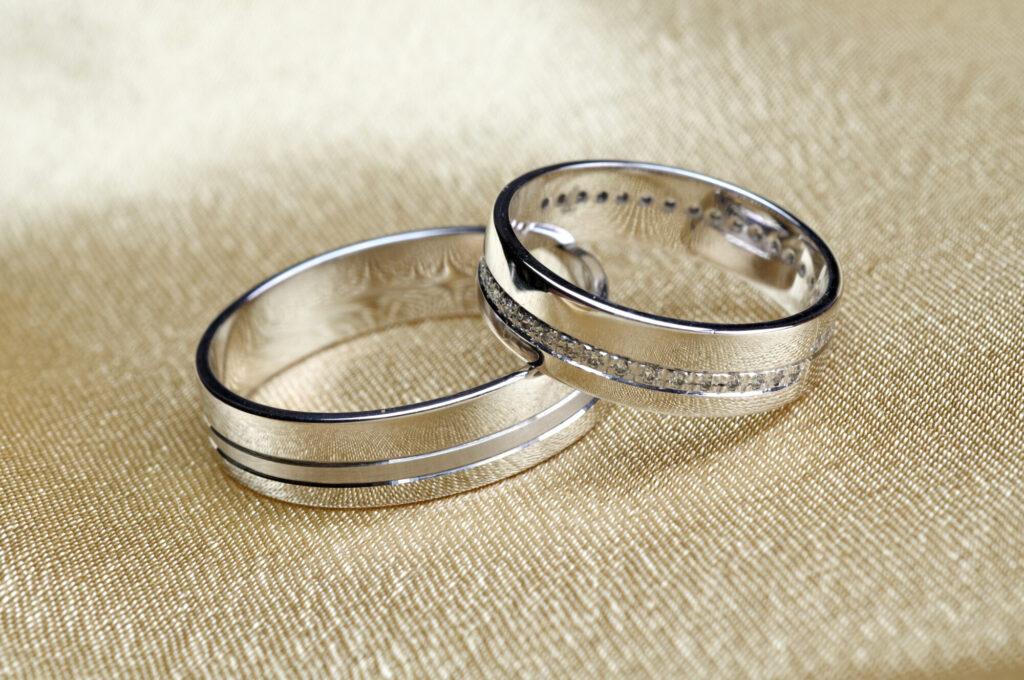
Details That Make a Ring Personal
A closer look at the details that give Kinzy wedding bands their individual character.
Frequently Asked Questions
Which wedding-ring finish shows the fewest scratches?
No finish prevents scratching. Texture changes how marks contrast with the starting surface. Choose based on the appearance you enjoy and a realistic maintenance plan.
Can a satin or brushed wedding ring be polished later?
A professional may be able to change or restore a finish, depending on the design, metal, dimensions and settings. Ask before purchase because altering the surface changes the intended look.
What is the difference between satin and brushed?
Satin generally appears finely and evenly diffused, while brushed finishes show a more directional grain. Terminology varies, so approve a physical reference.
Does a hammered finish make every ring unique?
Hand-applied texture naturally contains variation. The desired scale, depth and density should still be agreed so the finished ring suits the brief.
Can Kinzy help me compare finishes?
Start through the wedding-band builder, then arrange a consultation to view and confirm the relevant current options.
Final Thoughts: A Wedding Ring Finish Guide for Real Wear
A wedding ring finish guide should treat the surface as more than a final cosmetic switch. Polish, satin, brushing and hammering alter the way metal communicates, how new wear is seen and how future restoration should be approached.
Explore the Kinzy custom wedding-band builder and book a private consultation to compare the surfaces on the correct metal and profile.
×
WEDDING RING CONSULTATION
Tell us what you are considering.
A short, considered brief. Nothing needs to be certain yet.
This site is protected by reCAPTCHA and the Google Privacy Policy and Terms of Service apply.
WEDDING RING CONSULTATION
Choose a wedding ring that feels entirely yours.
From proportion and comfort to finish and fit, a short brief lets your Kinzy jeweller prepare considered options before your consultation.
Related Reading
Articles
Other articles from Kinzy London.
Articles, Buying Guides, Engagement Rings, Ring Settings
Cathedral vs Non-Cathedral Engagement Rings: What Changes from the Side?
Articles, Buying Guides, Engagement Rings, Ring Settings
Full Bezel vs Half Bezel: Which Setting Is Right for Your Diamond?
Articles, Buying Guides, Engagement Rings, Ring Settings