- Engagement Rings
- Wedding Bands
Shop by style
- Classic
- Diamond Cut
- Two Colour
- Diamond Set
- Shaped
- Vintage
- Gemstone Bands
Shop by metal
- Gemstones
- Fine Jewellery
Fine Jewellery
- About Us
- Education
15 August 2026
George Russell Engagement Ring: What Carmen Montero Mundt’s Yellow Ring Really Shows
The George Russell engagement ring is a vivid departure from the colourless solitaires that dominate celebrity proposals. When the Mercedes Formula 1 driver and Carmen Montero Mundt announced their engagement on 9 August 2026, the public photographs appeared to show a large elongated yellow centre stone flanked by two smaller pale stones.
That is enough to discuss a compelling design. It is not enough to authenticate a diamond, assign a colour grade or calculate a credible price. The Kinzy London view separates what the photographs genuinely reveal from the specifications only a jeweller and grading report could confirm.
George Russell Engagement Ring: The Confirmed Facts First
Russell and Montero Mundt shared the news in a joint Instagram carousel on Sunday, 9 August 2026. The brief caption consisted of a ring and white-heart emoji. The photographs place the proposal at a candlelit sunset dinner beside the water at an undisclosed location.
Cosmopolitan independently reported the 9 August announcement and described the centre as a yellow diamond. Russell’s official Formula 1 profile lists him as a British Mercedes driver, while an official Mercedes profile says the couple have been together since 2020.
No ring designer, laboratory report or technical specification accompanied the announcement. Therefore, the responsible description is visual: the centre appears elongated and oval-shaped, yellow in colour and arranged with two smaller pale side stones in a three-stone composition.
What the Public Photographs Do Not Prove
Several headlines have attached precise carat and value estimates to the ring. Those figures vary significantly. Perspective can enlarge a stone held towards a phone camera, while lighting and image processing can change apparent colour. Even an experienced jeweller cannot reliably determine weight from face-up spread without depth measurements.
The images also cannot establish whether the centre is a natural diamond, laboratory-grown diamond, treated diamond or another gemstone. They cannot verify a formal Fancy Light, Fancy, Fancy Intense or Fancy Vivid grade. No grading report, designer attribution or ring specification has been made public, so its carat weight, colour grade, origin and value remain unconfirmed.
This is exactly why a diamond certificate and a visual assessment perform different jobs. Kinzy’s diamond certification guide explains what a report can document, while our discussion of natural and laboratory-grown diamonds shows why origin cannot be guessed from appearance.
Why the Yellow Centre Stone Commands the Design
In a colourless diamond ring, buyers often discuss brightness, fire and contrast with the metal. In a strongly coloured centre, hue becomes the first impression. The setting can either reinforce warmth or create a cooler frame around it.
GIA explains in its fancy-colour diamond guidance that colour is the dominant value factor for fancy-colour diamonds. Hue, tone and saturation matter, and the face-up appearance can be influenced by the cut and mounting. That general principle is useful; it does not establish the grade of Carmen’s stone.
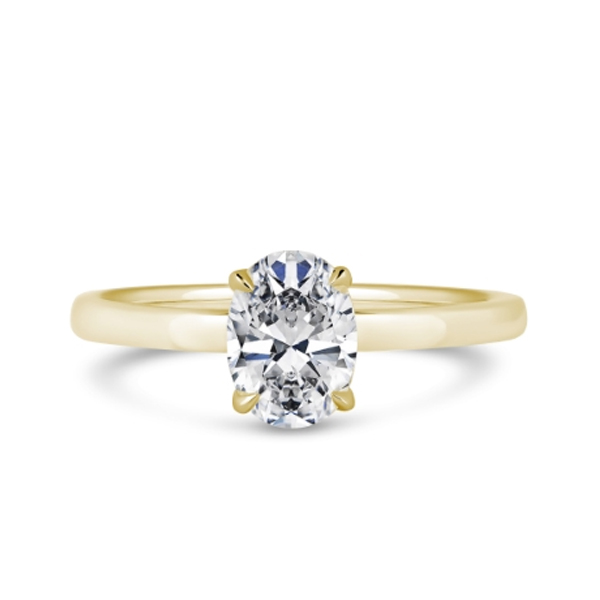
For a bespoke interpretation, compare several yellow stones loose and then against the proposed metal. Yellow gold can extend the warmth around a paler centre. Platinum or white gold can create stronger separation. A two-tone construction may keep a warm shank while giving the side stones or claws a cooler visual edge.
Kinzy’s guide to platinum versus gold engagement rings provides the practical metal context. The yellow-gold engagement-ring collection is useful for judging how warm metal changes the whole composition.
The Power of an Elongated Oval Outline
The apparent centre shape has generous north-to-south length. An elongated oval can create strong finger coverage without the hard corners of a geometric step cut. Its outline can feel fluid even at a statement scale.
However, “oval” is not one fixed proportion. Length-to-width ratio, shoulder fullness, symmetry and bow-tie visibility change the personality of every stone. Compare real candidates rather than ordering by carat and ratio alone. Kinzy’s oval engagement-ring guide and bow-tie effect explanation show what to inspect.
The setting must then be built around the exact outline. Claw positions, gallery rails and side-stone angles should protect the centre without making it look boxed in. Explore Kinzy’s engagement-ring settings guidebefore treating any celebrity photograph as a finished specification.
Why the Three-Stone Composition Feels Balanced
The two pale side stones appear to taper the visual journey from a substantial centre towards a finer shank. This creates width where the eye wants it, then releases the design towards the hand. It is a classic three-stone principle, but the strong colour contrast makes it feel more graphic.
Side stones should not be chosen independently. Their height, angle, outline and faceting must support the centre. Oversized sides can compete; undersized sides can look incidental. The transition should be judged from above, in profile and at normal viewing distance.
A three-stone arrangement also adds settings and junctions that need cleaning and inspection. Kinzy’s engagement-ring care guide explains daily precautions, while Lifetime Atelier Care sets out the current care route for eligible Kinzy creations.
Alex Albon and Lily Muni He: A Very Different F1 Ring Moment
Formula 1 driver Alex Albon and professional golfer Lily Muni He announced their engagement in a joint Instagram post on 16 January 2026. The official LPGA engagement report followed on 17 January, and GMA reported that the couple had been together since 2019.
The soft Polaroid-style announcement image gives only one useful ring view. It appears to pair a large pale, geometric-looking centre with a distinctive green-toned curved band. That combination is unquestionably dramatic. Yet the photograph is angled, reflective and too soft to verify the centre material, cut, carat, origin, green material or setting metal.
Some media descriptions call the centre heart-shaped; others call it octagonal and describe the band as jade. The image does not resolve that contradiction, so Kinzy would not promote either label as fact. What can be discussed is the design language: bold colour contrast, a broad centre outline and a sculptural shank that does not resemble a conventional all-metal band.
Two F1 Engagement Rings, Two Useful Design Lessons
| Visible design idea | George Russell and Carmen Montero Mundt | Alex Albon and Lily Muni He |
|---|---|---|
| First impression | A warm yellow centre within a recognisable three-stone composition. | A pale geometric centre contrasted with a curved green-toned band. |
| Source quality | Several public carousel views, but no official ring specification. | One soft announcement view, so technical identification is especially limited. |
| Design lesson | Use colour and graduated side stones to refresh a classic structure. | Let the shank material or colour become as expressive as the centre. |
| Do not assume | Diamond origin, grade, carat, value, maker, metal or exact setting. | Stone species, named cut, jade, carat, value, maker or construction. |
These rings should not become requests for copies. They are prompts for identifying the feature that creates the emotional response: yellow colour, elongated scale, trilogy balance, green contrast or unconventional structure. A personal design begins after that feature has been separated from the celebrity name.
How to Translate the Inspiration into a Kinzy Bespoke Ring
1. Choose the idea, not the alleged price
Begin with one sentence: “I love the yellow oval with pale sides,” or “I love the coloured curved band.” This creates a usable brief. An unverified valuation does not.
2. Establish the centre-stone priorities
Decide whether colour, outline, finger coverage, rarity, natural origin or budget matters most. View stones under more than one light and request documentation appropriate to the purchase. Kinzy’s gemstone collection and oval-cut engagement rings offer useful starting references.
3. Design every supporting element together
Side stones, claws, gallery, shank and wedding-band clearance should be resolved as one structure. Kinzy’s design process moves the brief into CAD and, where appropriate, a physical model so proportion can be reviewed before manufacture.
4. Test the ring at real scale
A magnified render can make delicate parts look heavy and a social photograph can exaggerate a centre held near the lens. Review full-hand views and actual dimensions. The aim is presence that belongs on the wearer’s hand, not a number chosen for a headline.
5. Keep the result recognisably yours
Change the ratio, side-stone shape, gallery motif, metal language or private engraving. Kinzy’s bespoke serviceis intended to build a one-of-one ring around the exact stones and wearer, supported by handcrafted jewellery expertise in Hatton Garden.
A Better Way to Read Any Celebrity Ring Photograph
- Confirm the event and date through the person’s original account or reputable reporting.
- Separate visible design from hidden specification. Colour and broad silhouette may be observable; origin and grade are not.
- Check whether estimates agree. Large conflicts are a warning against repeating numbers.
- Look for maker attribution. Do not assign a brand because a ring resembles its work.
- Respect image rights. Linking or embedding an authorised public post is not the same as owning the photograph.
- Turn inspiration into questions. Ask what you love and how it should work for your hand and life.
This method protects both accuracy and creativity. It is also consistent with Kinzy’s approach to bespoke engagement rings in London: inspect the real materials, discuss the real wearer and approve the real design.
Explore the Design Language with Kinzy
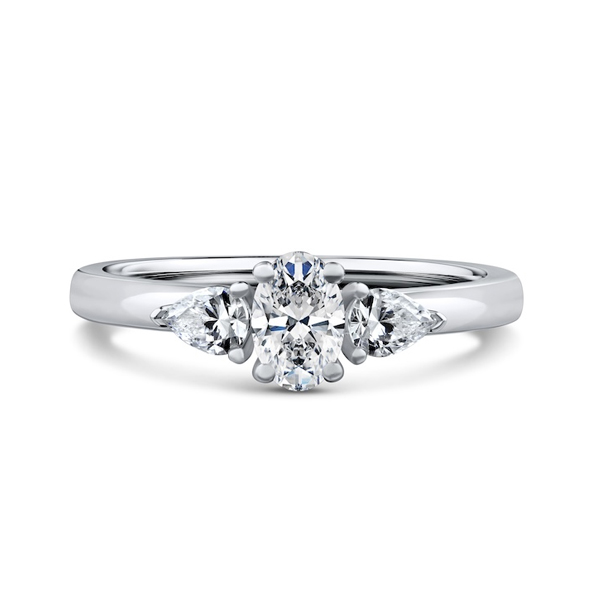
Use these Kinzy-owned references to compare oval proportion, warm metal and setting height without presenting them as the celebrity rings.
Related Reading and Services
- Engagement rings.
- Oval-cut engagement rings.
- Yellow-gold engagement rings.
- Kinzy craftsmanship.
- The Kinzy experience.
- Visit the Hatton Garden showroom.
- Book a private consultation.
See Kinzy Ring Detail on Instagram
This official Kinzy post provides a house-owned reference for considering centre-stone outline, setting detail and hand proportion.
Frequently Asked Questions
When did George Russell and Carmen Montero Mundt get engaged?
They announced their engagement in a joint Instagram post on Sunday, 9 August 2026. The photographs show a sunset proposal dinner beside the water; the location was not disclosed.
Is Carmen Montero Mundt’s engagement ring a yellow diamond?
It has been widely reported as a yellow diamond, and the centre appears yellow in the public photographs. However, no jeweller or grading report has publicly confirmed its identity, origin, treatment or formal colour grade.
What shape is the George Russell engagement ring?
The centre appears elongated and oval-shaped, with two smaller pale side stones. Exact measurements, side-stone shapes and setting construction have not been published.
How much is Carmen Montero Mundt’s ring worth?
No verified price is public. Media estimates vary and depend on assumptions about size, colour, origin and treatment. A photograph cannot support a reliable valuation.
When did Alex Albon and Lily Muni He get engaged?
They announced their engagement in a joint Instagram post on Friday, 16 January 2026. The image shows Lily presenting the ring in a soft Polaroid-style selfie.
Can Kinzy create a yellow three-stone engagement ring?
Kinzy can develop a one-of-one design around suitable available stones, the wearer and the practical brief. Begin with the bespoke service and book a private consultation to discuss colour, origin preference, side stones, setting and budget.
Final Thoughts on the George Russell Engagement Ring
The George Russell engagement ring is memorable because its apparent yellow centre and pale side stones transform a familiar trilogy format. The Alex Albon and Lily Muni He ring creates impact in the opposite way, with a sculptural green-toned band and a pale geometric centre.
Both offer valuable inspiration, provided photographs are not mistaken for certificates. Focus on the visible design decision that moves you, then create the proportions, materials and structure around the person who will actually wear the ring.
Explore Kinzy’s bespoke journey, discover the Kinzy experience or arrange a private Hatton Garden consultation.
Related Reading
Articles
Other articles from Kinzy London.
Articles, Bespoke Jewellery, Engagement Rings, Gemstones
How to Add a Hidden Birthstone or Secret Diamond to an Engagement Ring
Articles, Diamond Guides, Engagement Rings, Settings
Does a Bezel Setting Make a Diamond Look Bigger or Smaller?
Articles, Craftsmanship, Engagement Rings, Settings