- Engagement Rings
- Wedding Bands
Shop by style
- Classic
- Diamond Cut
- Two Colour
- Diamond Set
- Shaped
- Vintage
- Gemstone Bands
Shop by metal
- Gemstones
- Fine Jewellery
Fine Jewellery
- About Us
- Education
27 July 2026
Antique Diamond Cuts Explained: Old Mine, Old European, Rose Cut and Transitional Cut
Antique diamond cuts record how jewellers made, wore and viewed diamonds in different periods. Before computer modelling, motorised bruting and standardised cutting targets, cutters shaped each diamond by responding to the rough in front of them. The resulting stones can be shallow and quietly luminous, deep and fiery, visibly irregular or surprisingly close to the modern brilliant.
People often use terms such as rose cut, old mine cut, old European cut and transitional cut loosely. However, they do not describe one continuous “vintage” look. Each has a different architecture, period association and relationship with light. Understanding that vocabulary makes it easier to recognise what you are buying—and to design a ring that respects the diamond rather than disguising it.
A short timeline of antique diamond cuts and changing light
Hand tools constrained early faceting, and jewellers designed diamonds for social settings illuminated by daylight, fire and candles. Rose cuts offered a shimmering surface without a brilliant-cut pavilion. Old mine cuts introduced deeper brilliant-style faceting in cushion-like forms. Advances in shaping made rounder old European cuts possible. Transitional cuts then bridged those older proportions and the more standardised modern round brilliant.
The timeline is useful, but real diamonds resist perfect classification. Cutting practices overlapped, cutters recut stones and terminology developed after many diamonds had entered jewellery. Therefore, treat each name as a technical guide, then confirm the actual outline and facets. The GIA guide to old mine, old European and transitional cuts offers a useful gemmological comparison.
Antique diamond cuts compared
| Cut | Typical architecture | Characteristic light | Design impression |
|---|---|---|---|
| Rose cut | Flat base with a domed, faceted top; no brilliant pavilion | Soft surface shimmer and flashes | Low-profile, poetic and visibly historic |
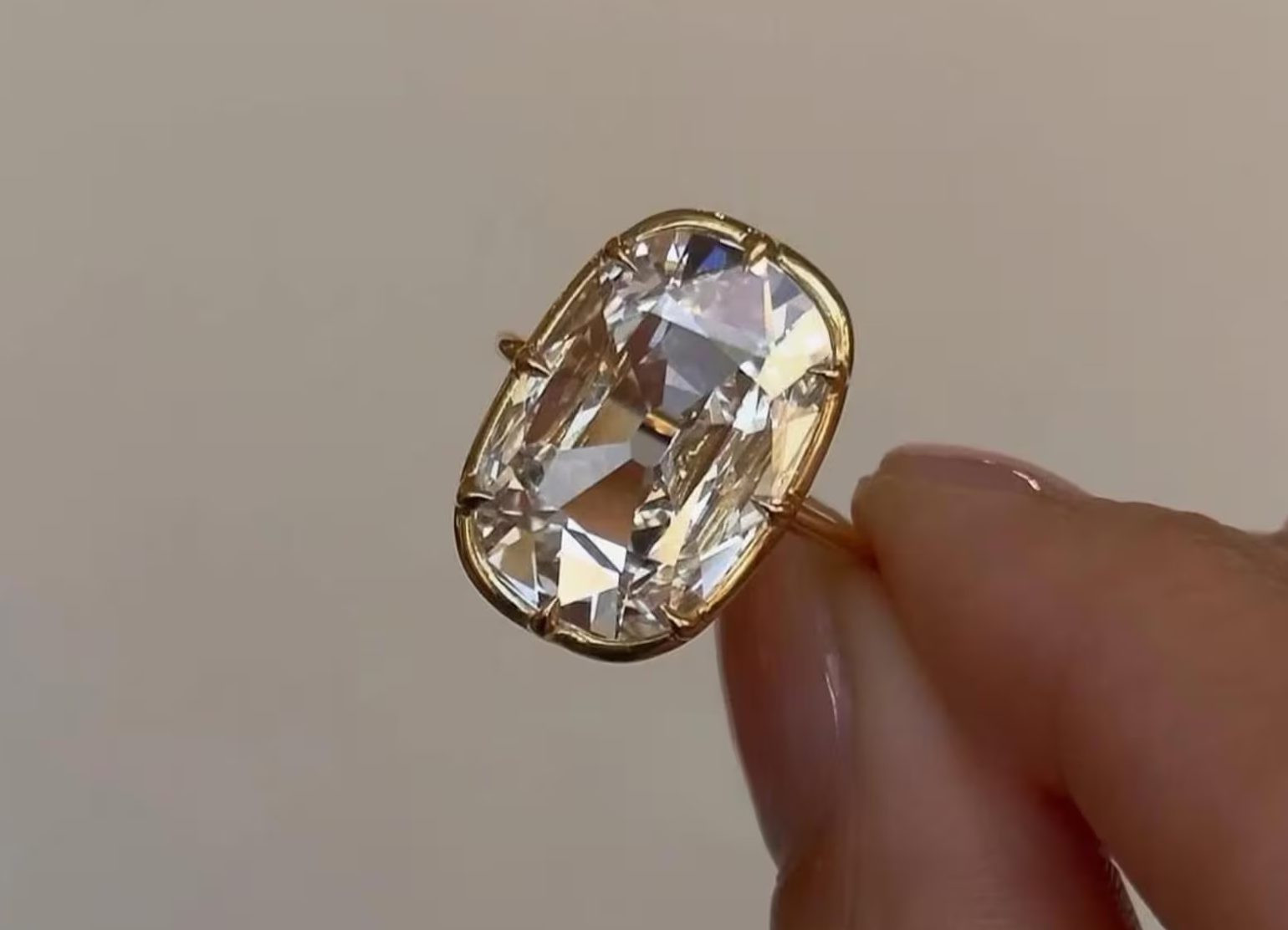
| Old mine cut | Cushion-like outline, high crown, small table, deep pavilion, open culet | Broad, irregular flashes | Romantic, individual and sculptural |
| Old European cut | Round outline, high crown, small table, deep pavilion, open culet | Broad radial flashes | Balanced, circular and distinctly different from a cushion outline |
| Transitional cut | Round form combining older proportions with emerging modern geometry | More organised brilliance with retained antique character | A bridge between old European and modern round brilliant |
Rose cut diamonds: light across the surface
A rose cut usually has a flat base and a crown formed from triangular facets rising towards a peak or ridge. Because it lacks the deep pavilion of a brilliant cut, it can sit low against the finger and appear larger across the surface relative to its weight. Its light is gentler: a shimmer and glint rather than intense scintillation.
Rose cuts can be round, oval, pear-shaped, irregular or made in paired forms. Their thin profile makes them sensitive to the colour of whatever sits beneath. A closed-back setting, reflective foil or coloured metal can materially change their appearance. Therefore, assess the complete jewel—not only the loose carat weight.
Choose a rose cut for subtle presence, historical character and a low silhouette. Do not choose it expecting the brightness of a modern brilliant; its beauty lies in a different optical language.
Old mine cuts: cushion outlines and candlelit flashes
Old mine cuts use brilliant-style faceting within softly squared or cushion-like outlines, rounded corners, high crowns, small tables and often prominent culets. Their irregularity reflects hand shaping and weight retention from the rough. Broad facets create large flashes that become especially expressive in warm, changing light.
Within the category, variation is enormous. For example, one stone can appear almost square while another looks distinctly elongated. Some have charming symmetry, while others feel visually unbalanced. Our dedicated old mine cut buyer’s guide covers outline, condition, certification and setting security in greater depth.
Old European cuts: antique brilliance in a round outline
The old European cut emerged as cutters gained greater control over a round girdle. It retains a small table, high crown, comparatively deep body and open culet, but organises them within a more circular plan. The face-up pattern often feels radial and balanced while remaining broader and less uniform than a modern round brilliant.
Consequently, the cut adapts exceptionally well to different designs. An old European diamond can anchor a faithful Edwardian-inspired ring, sit in a restrained six-claw solitaire or provide antique contrast within a clean contemporary design. For a direct decision guide, read old mine cut vs old European cut diamonds.
Transitional cuts: the category between eras
“Transitional cut” refers to diamonds showing the movement from old European proportions towards the modern round brilliant. No single universally fixed recipe defines the category. A transitional diamond may have a larger table, lower crown, smaller culet and longer lower-half facets than an old European cut, but retain more antique patterning than a fully modern brilliant.
The appeal is dual: a recognisably round stone with lively brilliance, but less mechanical visual uniformity. The risk is imprecise labelling. Ask which visible features support the description rather than accepting “transitional” as a romantic catch-all for any older round diamond.
What about single cuts, table cuts and portrait cuts?
Historic diamond cutting extends beyond the four headline categories. Jewellers often use single cuts, with their simpler brilliant arrangement, as small accent stones. Table cuts developed from the natural octahedral form and present a large flat table with restrained faceting. Traditionally, portrait cuts used very thin, transparent diamonds to cover miniature paintings or decorative elements.
Nevertheless, these cuts rarely answer the same buying question as a central old mine or old European diamond, but they matter when restoring a period jewel. Replacing antique accent stones with modern full cuts can disturb the original rhythm even if the measurements match.
“Antique cut” does not always mean “antique diamond”
However, a cutting style and a date of manufacture are separate claims. Cutters can fashion newly mined or laboratory-grown rough into rose, old mine or old-European-inspired cuts today. Conversely, later recutting can substantially alter an antique diamond until it no longer retains its original architecture.
Ask whether the seller is describing appearance, estimated age or documented provenance. A laboratory report can record measurements and gemmological characteristics, but it does not usually provide a complete ownership history. If a premium depends on provenance, the supporting evidence should be specific.
How to assess condition across antique diamond cuts
Interpret condition in relation to architecture. Old mine and old European diamonds may have very thin girdle areas vulnerable to chips. Rose cuts have shallow edges and may show abrasions or damage hidden by closed settings. Previous owners may also have repolished transitional diamonds, altering facet junctions or symmetry.
Examine the loose stone where possible. When the diamond sits in a mount, ask which areas the metal conceals. Note chips, cavities, bruises, abrasions, recut facets and replaced accent stones separately from clarity characteristics. Wear consistent with age may be acceptable; active structural risk requires a setting or restoration response.
Restoration, recutting and the value of restraint
Not every irregularity needs correction. Recutting can remove damage or improve optical balance, but it also removes carat weight and historic material. Moreover, replacing every worn component can make an antique jewel safer while erasing the qualities that made it significant.
A thoughtful restoration begins by defining the purpose: preserve a collectible object, make an heirloom wearable, or reuse its diamond in a new ring. The answer determines how much intervention is reasonable. Document the piece before work begins and retain removed original components where practical.
Matching antique diamond cuts to a modern engagement ring
- Rose cut: particularly suited to low bezels, closed backs, organic clusters and designs where softness matters more than maximum brilliance.
- Old mine cut: compelling in fine corner claws, sculptural collets, warm gold or a restrained halo that follows its individual outline.
- Old European cut: versatile in six-claw solitaires, milgrain halos, trilogy rings and modern round settings adapted to its depth.
- Transitional cut: effective when a client wants a round silhouette and energetic light with a quieter vintage reference.
In every case, a jeweller should build the mount around the exact stone. Stock settings can leave irregular girdles unsupported or force claws into visually awkward positions. Kinzy’s CAD and wax modelling process lets clients resolve protection, height and wedding-band fit before manufacture.
How to begin a serious comparison
- Decide whether authentic age, visual style or both matter to you.
- Compare one example of each relevant cut in the same lighting.
- Study silhouette and light before looking at grades.
- Check millimetre spread, depth and condition.
- Ask whether previous work altered, restored or replaced any element.
- Review the diamond beside the intended metal and setting.
- Request documentation for every historical claim that affects value.
Frequently asked questions
Which antique diamond cut sparkles the most?
There is no useful universal ranking. Transitional and old European cuts may produce more familiar brilliant-style activity, while old mine cuts offer broader irregular flashes and rose cuts a softer surface shimmer.
How do laboratories grade antique cuts?
Laboratories can grade colour, clarity and carat, but antique and most fancy shapes do not receive the standard GIA overall cut grade used for modern round brilliants.
Can a lab-grown diamond have an antique cut?
Yes. Cutters can apply antique-style faceting to laboratory-grown or natural rough. The cutting style does not establish geological origin or age.
Is visible asymmetry acceptable?
It can be. Gentle irregularity may be integral to a hand-cut stone; an outline or facet pattern that feels distractingly unbalanced should still affect selection and price.
Can Kinzy reset an antique diamond?
Suitability depends on condition. Kinzy should inspect the diamond first so the new setting can protect thin girdle areas, chips or other vulnerabilities.
Final thoughts
Understanding antique diamond cuts is not about memorising a timeline. It is about learning to see four different intentions: the rose cut’s surface light, the old mine cut’s cushion-shaped fire, the old European cut’s round antique rhythm and the transitional cut’s movement towards modern brilliance.
If you have an inherited stone or want to compare antique and antique-inspired diamonds, book a private consultation with Kinzy London. We can assess what the diamond is, what condition it is in and how to create a setting that feels personal without losing its character.
Related reading
Articles
Other articles from Kinzy London.
Articles, Bespoke Jewellery, Engagement Rings, Gemstones
How to Add a Hidden Birthstone or Secret Diamond to an Engagement Ring
Articles, Diamond Guides, Engagement Rings, Settings
Does a Bezel Setting Make a Diamond Look Bigger or Smaller?
Articles, Craftsmanship, Engagement Rings, Settings